
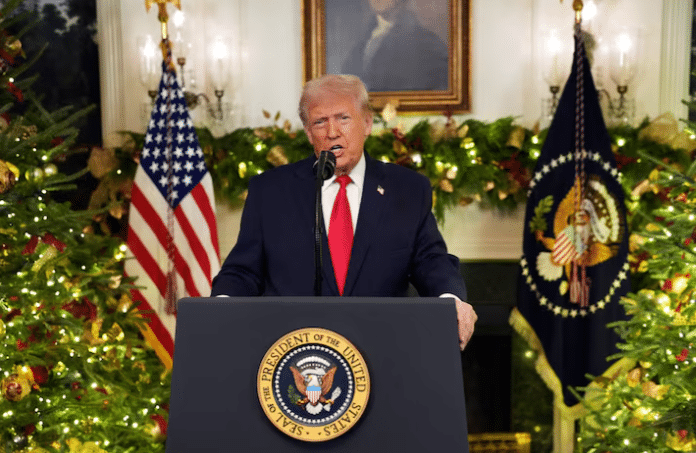
U.S. President Donald Trump used a rare holiday-season evening address from the White House to highlight what he described as major accomplishments of his second term, even as new polling shows declining public confidence in his handling of the economy.
Speaking for just under 20 minutes from the Diplomatic Reception Room, decorated for the holidays, Trump struck a combative tone, arguing that he inherited economic and social problems from the previous Democratic administration and is now reversing the damage.
“Less than a year ago, I walked into a broken system, and we are fixing it,” Trump said, delivering the speech at a rapid pace and with few new policy announcements.
The president placed responsibility for high consumer prices and broader economic strain on former President Joe Biden, past trade agreements, immigration policies and what he called entrenched corruption. He also revisited familiar grievances over border security, violent crime and transgender rights.
While acknowledging that many Americans are still struggling with high costs, Trump insisted the country is on the brink of an economic surge. He cited reduced border crossings, increased domestic investment and falling prices for select goods as evidence of progress, promising further improvements next year.
Among the limited policy measures announced, Trump said his administration would issue a one-time “warrior dividend” payment of $1,776 to about 1.45 million U.S. service members in the coming days. He also endorsed a Republican-backed proposal to provide Americans with direct cash assistance for health insurance instead of subsidies under the Affordable Care Act — a plan that currently lacks sufficient support in Congress.
“I want people to control their own healthcare spending,” Trump said, adding that insurers would be the only parties negatively affected.
Foreign policy received minimal attention during the address. Trump briefly mentioned the conflict in Gaza but made no reference to the war in Ukraine or rising tensions involving Venezuela, issues that dominated much of his first year back in office.
Economy Remains Political Pressure Point
The speech came as Republicans prepare for next year’s midterm elections, with economic affordability emerging as a central campaign issue. While Trump argued that inflation is easing, recent data shows consumer prices remain elevated, and job growth has slowed.
“I am bringing prices down, and it’s happening fast,” Trump said, pointing to tax cuts, tariffs and his stated intention to replace Federal Reserve Chair Jerome Powell.
However, a new Reuters/Ipsos poll released this week found that only 33 percent of U.S. adults approve of Trump’s economic management, underscoring the political challenge facing his administration.
Democrats were quick to criticize the address. Senator Mark Warner of Virginia said Trump offered “plenty of blame but few solutions,” while California Governor Gavin Newsom, widely seen as a future presidential contender, mocked the speech on social media.
Trump also claimed his policies had attracted $18 trillion in investment commitments, crediting tariffs and domestic manufacturing incentives. “A year ago, the country was stagnant,” he said. “Now we are the hottest economy anywhere in the world.”
The address came one day ahead of a closely watched inflation report from the Bureau of Labor Statistics. While inflation briefly fell to a four-year low earlier in Trump’s second term, it has since edged upward. Recent government figures also show rising unemployment and persistent cost-of-living pressures despite modest economic growth.